An Auguste Clape Masterclass
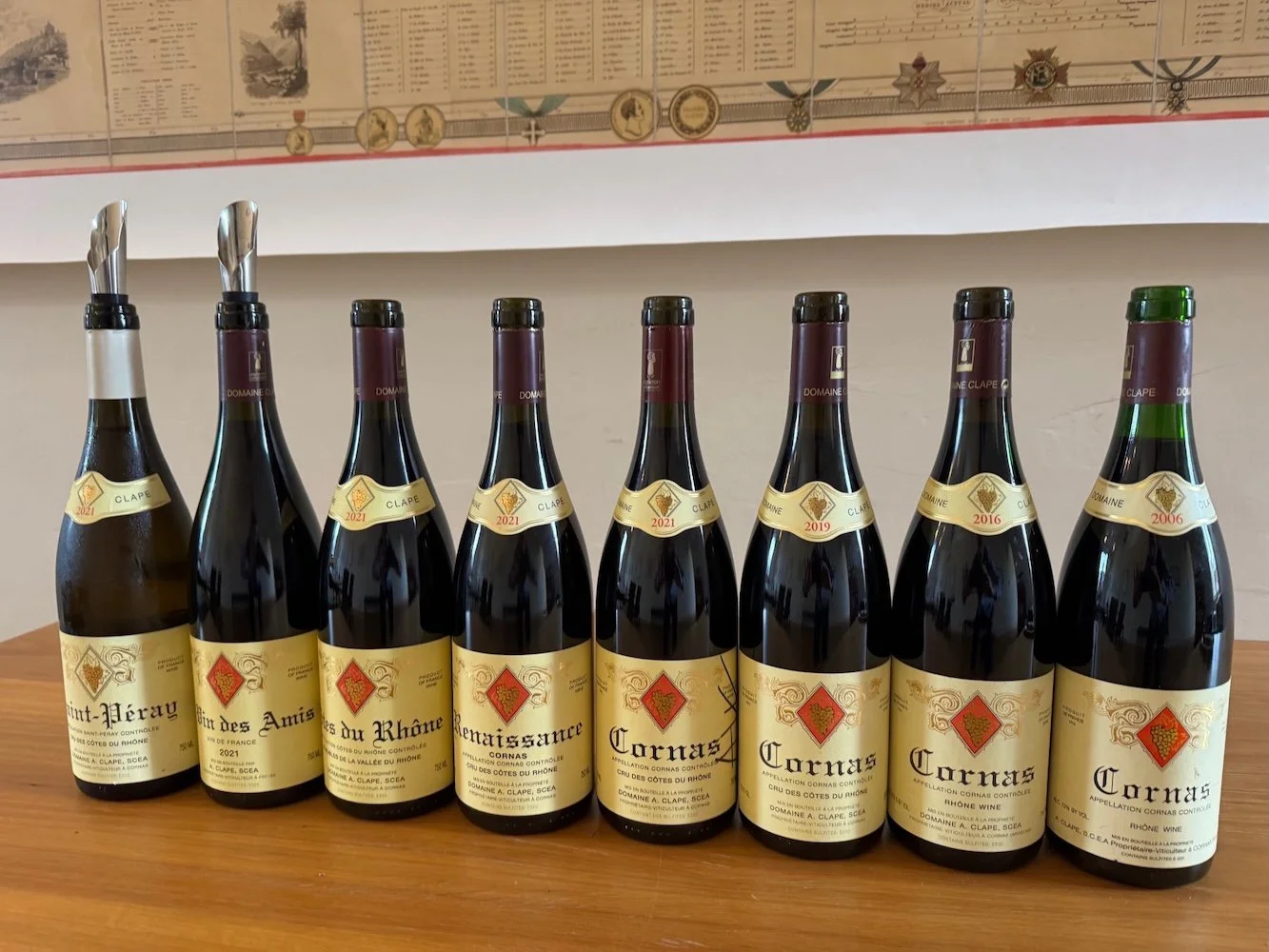
Premier Wine Tastings recently held an Auguste Clape wine tasting event at Melbourne’s Cardwell Cellars. This was a unique opportunity to taste the wines of this celebrated family-owned Domaine, regarded as a benchmark producer of Syrah from one of the top appellations of the northern Rhône, Cornas. It says something about the calibre of Clape’s Cornas, that they have presented verticals of it at the Len Evans Tutorial – which famously does a horizontal of Domaine de la Romanée-Conti on the final day of its intensive program. The tasting featured the full range of Clape’s wines from the 2021 vintage followed by back vintages of its top Cornas cuvée.
Cornas, which translates to “burnt earth”, is located in the southern part of the northern Rhône. It is set in a south and east facing amphitheatre that protects it from the Mistral and exposes it to the might of the sun. This, combined with its heat-absorbing granite soils and position away from the cooling influence of the Rhône, result in a hot microclimate where the grapes usually ripen earlier than at nearby Hermitage. Wines produced under this AOC must be 100% Syrah. They are known for being powerful, structured and age-worthy expressions of the variety, and increasingly for their finesse.
Auguste Clape started farming here in 1949 and was one of the first growers to bottle wine under his own name in 1955. Like many wine regions in Europe, the decades that followed World War II in Cornas were very challenging for vignerons. The steep vineyards had to be worked manually and the low prices obtained for the wines produced made it hard to make a living. Clape was a leading light through the lean years, when Cornas had a reputation for producing tough and rustic wines. Eventually the appellation began to shrug off this reputation and be recognised for its world-class quality. Auguste passed away in 2018 and his son Pierre-Marie, who joined in 1989, sadly died last year. The Domaine is now in the hands of Pierre-Marie’s son, Olivier. It has been organic since 2011 and currently farms approximately 8.5 ha, of which 5.28 ha is in Cornas.
The bottles were opened four hours prior to the tasting. Having contacted Olivier about the event, he advised that the best way to prepare the wines was to decant them. This would give them the opportunity to acclimatise to the oxygen and thereby become more open on the palate. He suggested that this would be particularly helpful for the 2019 Cornas, a “big wine !”
We started with the sole white produced by Clape, a Saint-Péray. This is an 80% Marsanne 20% Roussanne blend sourced from a 1 ha holding. What exactly characterises a typical Marsanne blend from Saint-Péray, or indeed the northern Rhône, is difficult to say because it can be made in a number of ways. Producer decisions concerning picking dates (earlier for fresher vs later for more robust), blend percentages, whether to allow malolactic conversion to take place and the choice of fermentation/maturation vessels (stainless steel, concrete, new oak and/or old oak etc.) all affect how the finished wine will taste. Some telltale signs, however, include stone fruit, honey, an oily texture and moderate acid. Andrew Jefford, in his book The New France, wryly suggests a “tendency to corpulence and low acidity.” In the case of the Clape, the Saint-Péray is fermented and aged in a combination of concrete and old foudres for around 11 months, with 100% malo, before being bottled unfiltered. The 2021 tasted was generous and textural with underlying verve and a slightly nutty oxidative note.
Moving onto the 2021 reds, we started with the Vin de France known as Le Vin des Amis Rouge. This is an earlier drinking style of Syrah from vineyards just south of the village. It was red fruited with fine, powdery tannins. Then came the Cotes du Rhone, which comes from two parcels. One is within Saint-Péray and includes some 1890 and 1895 vines and the other is just beneath the boundary of Cornas. It may also include press wine from young-vine Cornas fruit. Here there was a step up in the intensity of the fruit and quality of the tannin – a trend that continued and was more noticeable with the Renaissance Cornas. This wine, made since 1998, is a blend of younger vines Cornas from the Domaine’s best sites in the appellation and older vines from the lower slopes.
Both the Renaissance and top Cornas cuvées are produced in a traditional manner. Fermentation is 100% whole bunch in concrete vats for about twelve days using indigenous yeast. The stems add structure and a subtle herbal complexity. Importantly in the context of climate change, they also contribute a perceived freshness and reduce alcohol. Pigeage occurs twice daily and there is some pumping over. The wine is then aged in the photogenic old foudres for which the Domaine is well known.
Interestingly, Clape age their wines according to the age of the vines that the grapes come from rather than specific plots. This was demonstrated when I tasted in the cellar in 2022. We began tasting from foudres containing wine from younger-vine fruit (about 15 - 20 years old), eventually progressing to one containing wine from 130-year-old vine fruit from the famous Reynard site. This was a surreal experience. As the vine source got older, the wine tended to become finer, with a denser structure and more intense and darker fruit. Why do this, though? According to Olivier, while Cornas has different aspects, the terrior in the heart of the appellation is more or less the same (granite) and it makes more sense to make a separation on the basis of vine age.
Maturation lasts eighteen months. During this time there are several rackings to avoid the excessive reduction to which Syrah is prone. The blending process then occurs with any wine that is found to be atypical being declassified to a lesser wine. Typically the top Cornas is made up of cuvées from the oldest plots and best sites. After blending, the wine is then returned to foudre for a number of months prior to bottling unfiltered.
The 2021 Cornas provided a real counterpoint to the 2019 that followed. This was a reflection of the widely different vintage conditions. 2021 was a cold and rainy year (vigneron Thierry Allemand has said of 2021, it’s a vintage “we adore…like in the old days”) whereas 2019 was a “solar” vintage that was hot and dry. As would be expected, the 2021 showed more restraint and had lower alcohol (12% compared to the 2019’s 13.5%). I personally found the austerity and mineral-inflected fruit of the 2021 appealing, which was consistent with my preference for that vintage compared to the (warm) 2020 vintage when tasting in the cellars of Clape and fellow Cornas producer Franck Balthazer. The 2019, on the other hand, lured us in with its intense ripe black fruit, game and violet lift on the nose and velvety mouthfeel on the palate. It was preferred to the 2021 by the majority of the group.
The next bracket looked at Clape’s Cornas at 10 and 20 years of age to give us an idea of how the wines evolve with time. 2016 was a near-perfect vintage in the northern Rhône and could be said to have more precision than 2019. It was a wine of great purity and balance and still very young - the firm tannins evoking Cornas’ granite vineyards. This was the wine of the day for me with its harmony and honed power. Whereas it still has a long life ahead of it, the 2006 that followed was structurally resolved showing attractive brambly fruit, dried plum and tilled earth, and a more gentle mouthfeel.
A blind vintage was then thrown in for good measure, a 2013. This was a somewhat challenging year that was saved by warm conditions at the end. Its floral aromatics and linear drive on the palate telling the story. It summed up one of the (many) great pleasures of the tasting – the transparency of Clape’s wines, which allows the vintages to speak.